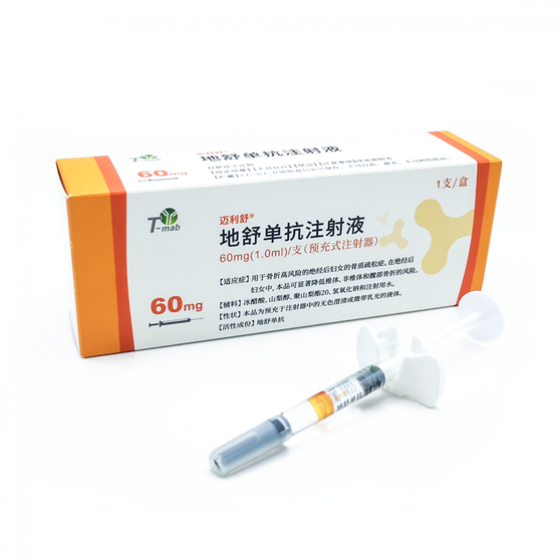
- Details
- Description
-
Packaging Size1 pre-filled pen
-
Strength60mg(1.0ml)
-
CompositonDenosumab
-
TreatmentOsteoporosis, treatment-induced bone loss, metastases to bone, and giant cell tumor of bone
-
FormInjection
-
BrandMAILISHU
-
Quantity Unit60mg(1.0ml)/vial
-
ManufacturerMabwell (Shanghai) Bioscience Co., Ltd.
About Denosumab
Denosumab is an inhibitor of RANKL (receptor activator of nuclear factor kappa-Β ligand), which works by decreasing the development of osteoclasts, which are cells that break down bone. Denosumab is a human monoclonal IgG2 antibody that targets the protein RANKL, which is essential for the formation, function and survival of osteoclasts, the cell type responsible for bone resorption. Denosumab binds to RANKL with high affinity and specificity, preventing the interaction between RANKL and RANK (receptor activator of nuclear factor-kappa B). Increased osteoclast activity stimulated by RANKL is a key mediator of bone destruction in metastatic bone disease. This leads to a reduction in osteoclast numbers and function, and a decrease in bone resorption, cancer-induced bone destruction. It also leads to a decrease in bone resorption in cortical and trabecular bones.
- MAILISHU (Denosumab) Biosimilars to Prolia
- MAIWEIJIAN (Denosumab) Biosimilars to Xgeva
Osteoporosis
MAILISHU (Denosumab) Biosimilars to Prolia
Indicated for postmenopausal women with osteoporosis at high risk for fracture (defined as history of osteoporotic fracture, or multiple risk factors for fracture; or patients who have failed or are intolerant to other available osteoporosis therapy)
Indicated for treatment to increase bone mass in men with osteoporosis at high risk for fracture
60 mg SC q6months
Aromatase Inhibitor Induced Bone Loss
MAILISHU (Denosumab) Biosimilars to Prolia
Indicated as a treatment to increase bone mass in women at high risk for fracture receiving adjuvant aromatase inhibitor therapy for breast cancer
60 mg SC q6months
Androgen Deprivation Induced Bone Loss
MAILISHU (Denosumab) Biosimilars to Prolia
Indicated as a treatment to increase bone mass in men at high risk for fracture receiving androgen deprivation therapy for nonmetastatic prostate cancer
60 mg SC q6months
Glucocorticoid Induced Osteoporosis
MAILISHU (Denosumab) Biosimilars to Prolia
Indicated for glucocorticoid-induced osteoporosis in men and women at high risk of fracture who are either initiating or continuing systemic glucocorticoids equivalent to ≥7.5 mg/day of prednisone and are expected to remain on glucocorticoids for at least 6 months
60 mg SC q6months
Skeletal-Related Events
MAIWEIJIAN (Denosumab) Biosimilars to Xgeva
Indicated for prevention of skeletal-related events (SREs; eg, bone fractures and pain) in patients with multiple myeloma and in patients with bone metastases from solid tumors
120 mg SC q4Weeks
Giant Cell Tumor
MAIWEIJIAN (Denosumab) Biosimilars to Xgeva
Indicated for treatment of adults and skeletally mature adolescents with giant cell tumor of bone in whom surgical resection is impossible or is likely to result in severe morbidity
120 mg SC q4Weeks
Give 2 additional 120 mg doses during the first month of therapy on Days 8 and 15
Hypercalcemia of Malignancy
MAIWEIJIAN (Denosumab) Biosimilars to Xgeva
Indicated for treatment of hypercalcemia of malignancy refractory to bisphosphonate therapy
120 mg SC q4Weeks
Give 2 additional 120 mg doses during the first month of therapy on Days 8 and 15
Dosage Modifications
Hepatic impairment: Safety and efficacy not evaluated
Renal impairment
- No dosage adjustment necessary
-
CrCl <30 mL/min or receiving dialysis
- Xgeva (and biosimilars): Greater risk of developing hypocalcemia (see Cautions)
- Prolia (and biosimilars): Review risks versus benefits for chronic kidney disease-mineral bone disorder and risk of hypocalcemia (see Black Box Warnings)
Dosing Considerations
Verify pregnancy status of females of reproductive potential before initiating
Administer calcium (1000 mg/day) and vitamin D (400 IU/day) as necessary to treat or prevent hypocalcemia
Patients receiving Prolia, Jubbonti, or Ospomyv should not receive Xgeva, Wyost, or Xbryk (see Cautions)
Monitoring parameters
- In patients with advanced chronic kidney disease (CKD) ie, eGFR <30 mL/min/1.73 m2, including dialysis-dependent patients, evaluate for presence of CKD mineral and bone disorder (CKD-MBD) with intact parathyroid hormone (iPTH), serum calcium, 25(OH) vitamin D, and 1,25 (OH)2 vitamin D before decisions regarding treatment
- Consider assessing bone turnover status (serum markers of bone turnover or bone biopsy) to evaluate underlying bone disease that may be present