- Details
- Description
-
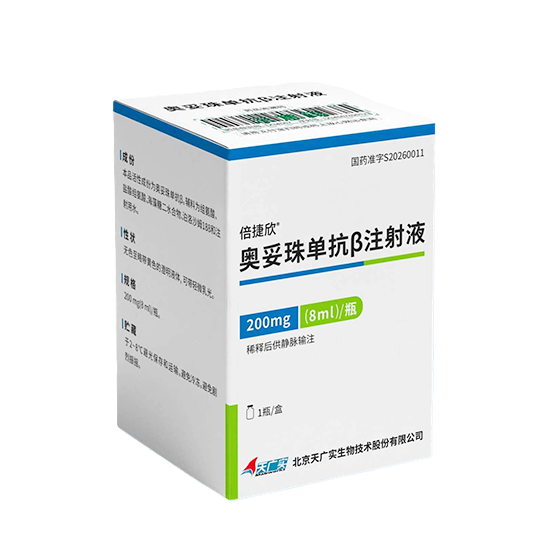
Packaging Size1 vial/Bottle
-
Strength200mg(8ml)
-
Compositonobinutuzumab
-
TreatmentNeuromyelitis optica spectrum disorders,NMOSD
-
FormInjeciton
-
BrandBejescin® (倍捷欣®)
-
Quantity Unit200mg(8ml)*1Bottle/Box
-
ManufacturerMabworks, China
About Obinutuzumab
Obinutuzumab is a fully humanized monoclonal antibody that binds to an epitope on CD20 that partially overlaps with the epitope recognized by rituximab.
Neuromyelitis optica spectrum disorders (NMOSD)
Obinutuzumab is approved in China for the treatment of Neuromyelitis optica spectrum disorders (NMOSD).
First-year dosage: 20 vials × 200mg/8ml/box [5 (week 1) + 5 (week 3) + 5 (week 25) + 5 (week 27)]
Second-year treatment: 5 vials every six months.
Chronic Lymphocytic Leukemia
Indicated for previously untreated chronic lymphocytic leukemia in combination with chlorambucil
Administer for 6 treatment cycles (28-day cycles)
Cycle 1
- Day 1: 100 mg IV
- Day 2: 900 mg IV
- Days 8 and 15: 1000 mg IV
Cycles 2-6
- Day 1: 1000 mg IV
Follicular Lymphoma
Relapsed or refractory to rituximab-containing regimen
- Indicated for patients with follicular lymphoma (FL) who relapsed after, or are refractory to a rituximab-containing regimen; administer in combination with bendamustine (six 28-day cycles) followed by obinutuzumab monotherapy for up to 2 years
Previously untreated stage II bulky, III or IV FL
- Indicated for patients with untreated stage II bulky, III or IV FL in combination with chemotherapy followed by obinutuzumab monotherapy
- Six 28-day cycles in combination with bendamustine, OR
- Six 21-day cycles in combination with CHOP, followed by 2 additional 21-day cycles of obinutuzumab alone, OR
- Eight 21-day cycles in combination with CVP
- If complete response or partial response to initial 6 or 8 cycles achieved, continue on obinutuzumab 1000 mg monotherapy for up to 2 years
Dosage regimen
- Cycle 1: 1000 mg IV on Days 1, 8, and 15
- Cycles 2-6 or 2-8: 1000 mg IV on Day 1
- If complete or partial response achieved, continue with obinutuzumab 1000 mg q2Months as monotherapy for up to 2 years
Monotherapy
- 1000 mg IV q2months for up to 2 years
Lupus Nephritis
Indicated for active lupus nephritis (LN) who are receiving standard therapy
Dose 1: 1000 mg IV
Dose 2: 1000 mg IV administered 2 weeks after dose 1
Dose 3 (Week 24): 1000 mg IV
Dose 4 (Week 26): 1000 mg IV administered 2 weeks after dose 3
Dose 5 and thereafter: 1000 mg IV administered 6 months after dose 4, and then every 6 months afterwards
Dosage Modifications
Consider treatment interruption, if an infection, Grade 3 or 4 cytopenia, or a Grade ≥2 nonhematologic toxicity occurs
Grade 1-2
- Reduce infusion rate or interrupt infusion and treat symptoms; upon resolution, continue/resume infusion and, if no further IRR occurs, infusion rate escalation may resume at increments and intervals as appropriate for treatment cycle dose
- CLL patients only: Day 1 infusion rate may be increased back up to 25 mg/hr after 1 hr, but not increased further
Grade 3
- Interrupt infusion and manage symptoms; upon resolution of symptoms, consider restarting infusion at ≤50% of previous rate and, if no further IRR occurs, infusion rate escalation may resume at the increments and intervals as appropriate for the treatment cycle dose
- CLL only: Day 1 infusion rate may be increased back up to 25 mg/hr after 1 hr, but not increased further
- FL with Grade 3 IRRs during 90-minute infusion: Upon resolution of symptoms, restart infusion at no more than half the previous rate (rate used at the time that IRR occurred) and not to exceed 400 mg/hr; subsequent infusions at the standard rate
- Permanently discontinue treatment if Grade ≥3 infusion related symptom if rechallenged
Grade 4
- Stop infusion immediately and permanently discontinue
Marginal Zone Lymphoma (Orphan)
Orphan designation for treatment of splenic marginal zone lymphoma